
Holmes County Court Records After a Jail Arrest
After a Holmes County arrest, two record systems run side by side. The sheriff holds the booking and jail side. The court holds the charge side. When someone is booked into the Holmes County Jail, the case is handed to the Office of the State Attorney for the 14th Judicial Circuit, which decides whether to file charges. Those filed charges open a case with the Holmes County Clerk of Court, and that case becomes the court record people search after an arrest.
It helps to keep the two sides apart. For the custody and booking side, the jail inmate records page covers the roster channels, and the jail mugshots page covers booking photos. This page stays on the court record, which is the set of charges the prosecutor actually files and the docket that follows them. Booking charges and filed court charges are not always the same, and that gap is the main reason an arrest record and a court record can read differently.
Find Holmes County Court Records After Arrest
Holmes County court records are searched online through the Civitek Online Court Records Search, reached from the clerk's office. The portal opens with a disclaimer that the data is informational and not the authoritative legal record, so a certified copy still comes from the clerk. After agreeing, you can search by person or by case number.
The official Holmes County court records search begins at this disclaimer screen.
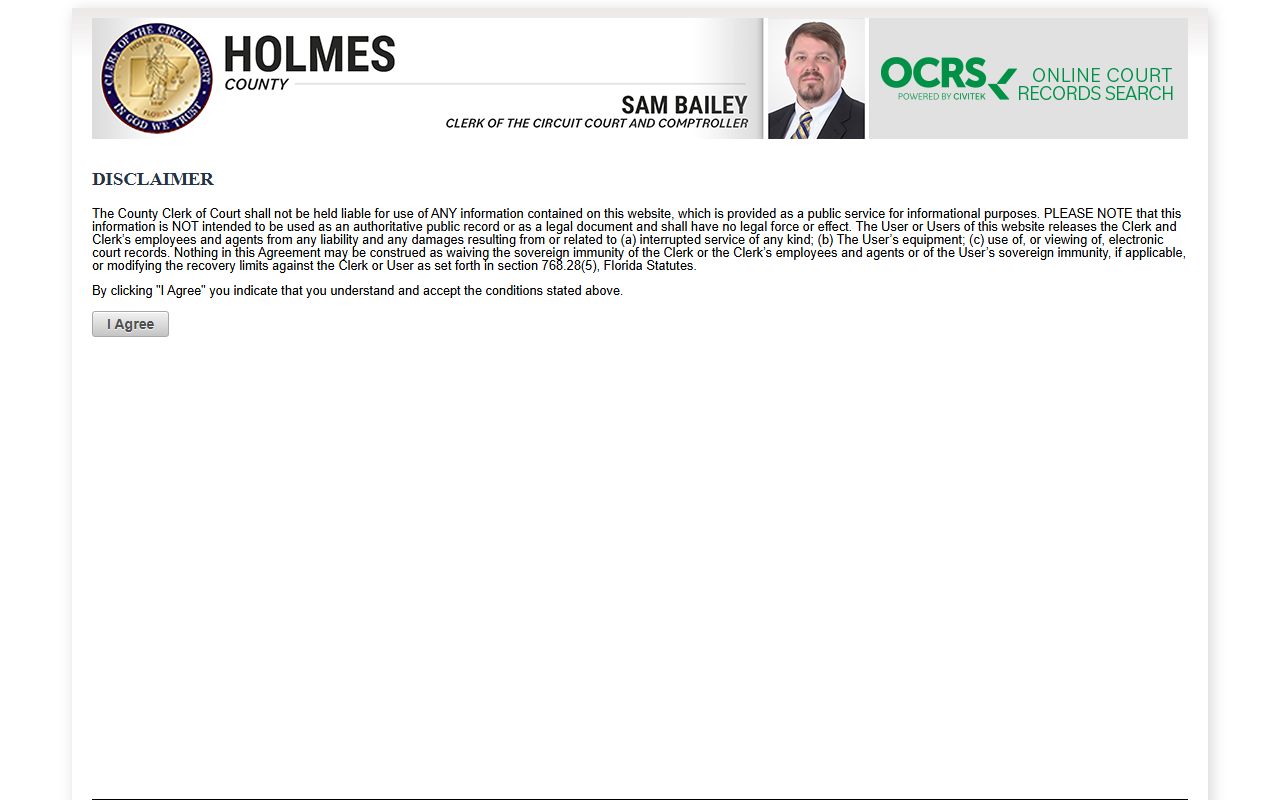
From there, the person search is the usual starting point when you do not have a case number.
- Open the Civitek court records portal and click I Agree on the disclaimer.
- Use Person Search and enter the last name, with first name or date filed to narrow it.
- Filter by criminal court types such as Felony, Misdemeanor, or Criminal Traffic.
- Open the case and read the charges, hearings, bond orders, and disposition.
| Field | Search | Required | Notes |
|---|---|---|---|
| Last Name or Business Name | Person | Yes | Core field for a person search. |
| First Name / MI | Person | No | Narrows common surnames. |
| Date Case Filed From / To | Person | No | Useful right after a recent arrest. |
| Court Type checkboxes | Person | No | Felony (CF), Misdemeanor (MM), Criminal Traffic (CT), and more. |
| Year, Court Type, Sequence # | Case | Yes | All three required to pull a case by number. |
If the online record is missing, sealed, or too old, the clerk can be reached in person, by phone at 850-547-1100, or by mail at 201 N. Oklahoma Street, Bonifay.
How Holmes County Charges Get Filed
The court record does not begin at the jail. It begins when a charging document is filed. After booking, the State Attorney reviews the arrest and decides how to proceed. In Florida, most felonies move forward on an information filed by the prosecutor, while a grand jury indictment is used for the most serious matters and many misdemeanors begin with a complaint or the prosecutor's filing.
| Complaint | Information | Indictment | |
|---|---|---|---|
| Filed By | Officer or prosecutor | State Attorney | Grand jury |
| Common For | Misdemeanors | Many felonies | Serious felonies |
| Starts | The case | The case | The case |
A booking charge can be dropped, reduced, combined, or replaced once the prosecutor reviews the file, so the charge that opens the court record may differ from the one written at arrest.
Holmes County Court Charge Status
Charges change as a case moves through court, and the docket tracks each step. Reading the status is how you tell a still-active charge from one that has already ended. The terms below appear often in Holmes County criminal dockets.
| Status | What It Means |
|---|---|
| Pending | The charge is active and the case has not been resolved. |
| Amended or reduced | The prosecutor changed the charge or lowered its level. |
| Dismissed | The charge ended without a conviction. |
| Nolle prosequi | The prosecutor chose not to proceed on the charge. |
A dismissal or a nolle prosequi is not the same as having a record erased. The court and booking record can still exist unless it is sealed or expunged.
State Attorney and Holmes County Charges
The prosecutor is the office that turns an arrest into court charges. Holmes County falls in the 14th Judicial Circuit, led by State Attorney Larry Basford, whose circuit also covers Bay, Calhoun, Gulf, Jackson, and Washington counties. The Holmes County office in Bonifay handles local cases, and the office announced Jacob Cook as Chief Prosecutor for Holmes County in early 2024.
The 14th Judicial Circuit State Attorney's Office publishes its circuit and contacts online.
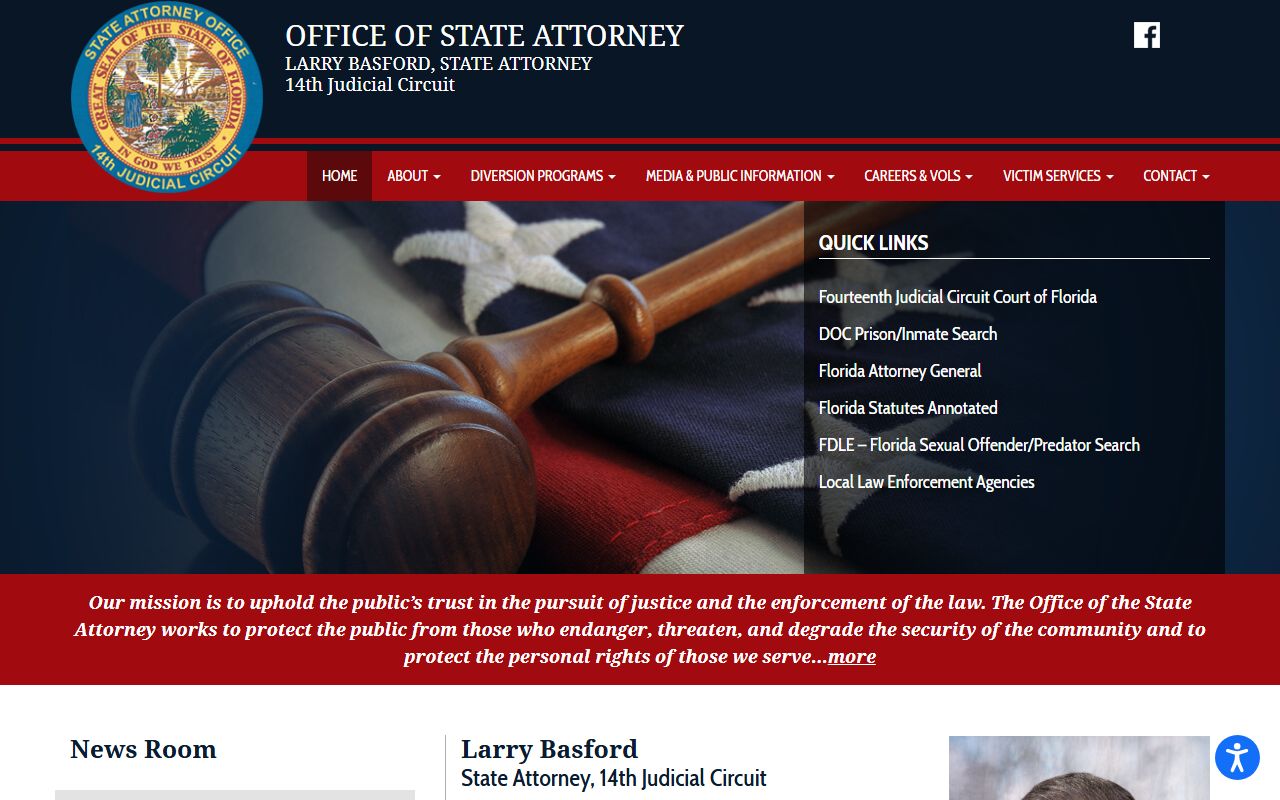
Court dockets and filed charges are searched through the clerk, but prosecutor-office records that are not in the public docket are requested from the State Attorney's public-records channel at PublicRecords@sa14.fl.gov.
Which Office Holds Holmes County Records
A Holmes County arrest creates records in more than one office, and sending a request to the wrong one wastes time. The custody and booking side belongs to the sheriff. The court charge side belongs to the clerk. The prosecution side belongs to the State Attorney. After sentencing to state prison, the record moves to the Florida Department of Corrections. The list below sorts the most common requests by office.
- Holmes County Sheriff holds booking records, arrest reports, jail custody records, booking photos, and incident reports.
- Holmes County Clerk of Court holds the court docket, filed charges, hearing dates, dispositions, court orders, and certified copies.
- State Attorney, 14th Circuit holds prosecution and charging records that are not part of the public docket.
- Florida Department of Corrections holds custody and supervision records once a person is sentenced to state prison.
Timing matters as much as office. On the day of arrest, the jail phone is the most useful source because the court case may not be indexed yet. After first appearance, bond and initial court information may be available, since booking receives first-appearance results around 11:00 a.m. After the State Attorney files, the formal charges should show in the court docket if they are public. After a prison sentence, the state corrections locator becomes more useful than any county channel.
Bond After a Holmes County Arrest
Bond is decided early. Anyone who does not bond out routinely sees a judge within twenty-four hours of arrest, and the judge states the charges and may set a bond amount. The sheriff says full bond is paid by cashier's check, certified check, or money order made out to the Holmes County Clerk of Courts, and jail staff cannot recommend a bondsman. A hold from another agency or case can keep a person in custody even after one bond is posted.
- Cash or full bond is paid to the clerk to secure release and future appearances.
- Surety bond is posted by a licensed bail agent for a fee or collateral.
- Own recognizance or time served can release a person without full bond in some misdemeanor cases.
- No-bond hold blocks release until a court or the holding agency changes the status.
Note: Confirm release eligibility with the jail and the court before paying any bond, because an outside hold can keep a person in custody after one bond clears.
Warrants That Lead to an Arrest
Many arrests start with a warrant. Holmes County has no public online warrant search, so a warrant is checked through other channels. A bench warrant or capias often appears in a criminal or traffic case once it is entered, which makes the Civitek court search a practical place to look. The sheriff's records section can also be asked for releasable warrant-related records, and dispatch can confirm a custody status after a warrant arrest.
No online result is not proof that no warrant exists. Anyone unsure about a warrant should check the court case or speak with an attorney rather than rely on the absence of an online hit.
Charges After an Arrest vs. Convictions
An arrest and a charge are accusations. A conviction is an outcome. The court record shows both stages, and confusing them is a common mistake when reading a case after an arrest.
| Charge | Conviction | |
|---|---|---|
| Stage | Accusation | Verdict or plea |
| Burden of Proof | Probable cause | Beyond a reasonable doubt |
| Public Record | Yes | Yes |
Sealing vs. Expunging an Arrest Record
Florida lets some people clear an eligible arrest record after a dismissal or qualifying outcome. The first step is a certificate of eligibility, and relief is not complete until the Florida Department of Law Enforcement receives a certified court order. Court-ordered expunction runs under Florida Statutes § 943.0585, and court-ordered sealing runs under Florida Statutes § 943.059.
| Sealed | Expunged | |
|---|---|---|
| Visibility | Hidden from public view | Destroyed and treated as if it never existed |
| Law Enforcement | Limited access remains | Very limited access |
| Eligibility | Set by Florida statute and prior history | Often after a dismissal or eligible disposition |
Restricted Holmes County Court Records
Not every court record after an arrest is open. Under Florida Statutes § 119.0714, court files are generally public unless closed or exempt, and the clerk must protect sensitive data like Social Security and account numbers. Juvenile cases, sealed or expunged charges, protected victim information, and active investigations may not appear in the public portal.
Important: This is a private reference site and not a consumer reporting agency under the FCRA, so nothing here may be used for employment, housing, credit, or other FCRA-covered screening.